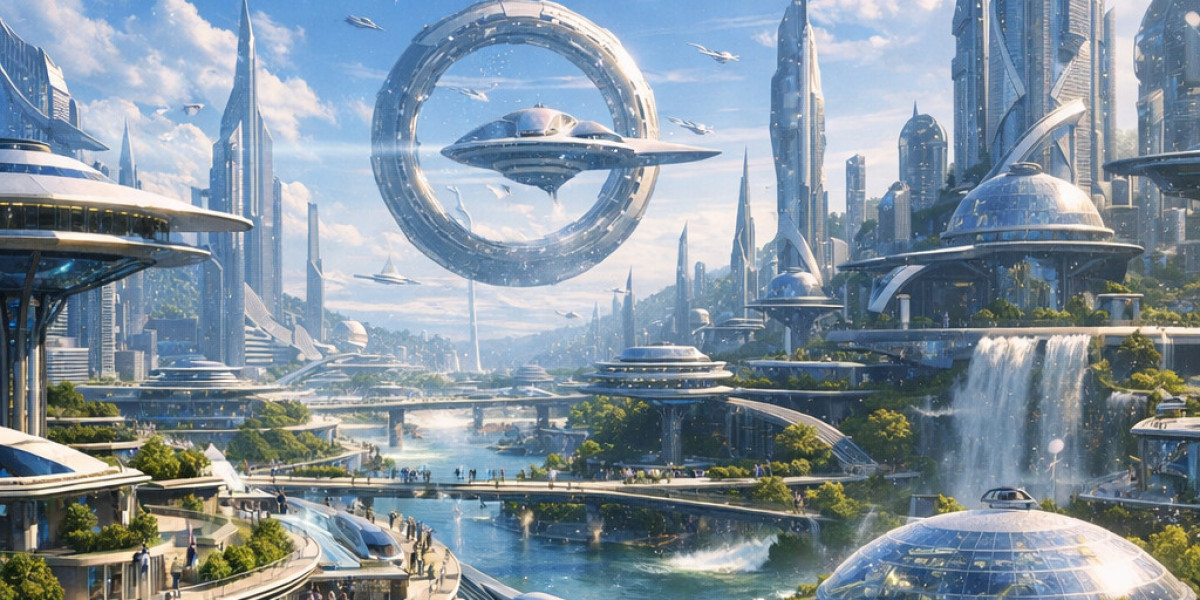
Welcome to the year 2526. It is a world 500 years in the future.
To us, this sounds like a dream, or perhaps a movie. But as the science fiction writer Arthur C. Clarke famously wrote:
"Any sufficiently advanced technology is indistinguishable from magic." Arthur C. Clarke, "Profiles of the Future" (1962)
Just as a smartphone would look like a magic mirror to a knight from the Middle Ages, the year 2526 will look like magic to us. But it isn't magic. It is science. Let's explore this brave new world, step by simple step.
1. The Planet: We Finally Fixed the Weather
Right now, in the 21st century, we worry a lot about the planet getting too hot. This is called Climate Change. By 2526, humans will have likely mastered Geoengineering.
In 500 years, cities might not look like concrete jungles. They will likely be "Solarpunk." This is a style where high technology mixes with nature. Picture skyscrapers that look like giant trees, covered in leaves that clean the air, powered entirely by the sun.
We might even be "Terraforming" other planets. Terraforming means taking a dead planet, like Mars, and using science to give it air, water, and plants so humans can breathe there without spacesuits.
2. The Body: Cheating Death
Today, everyone gets old. Our hair turns gray, our skin gets wrinkly, and our bodies stop working. In 2526, aging might be considered a disease—one that we can cure.
We will do this using CRISPR and Nanotechnology.
By 2526, we won't just fix typos; we will rewrite the book. Parents might choose their children's eye color or make sure they never get cancer.
We might also have Nanobots. These are robots so small you can't see them with your eyes. Millions of them could swim in your blood, hunting down viruses and fixing broken bones from the inside out. As the historian Yuval Noah Harari notes in his book Homo Deus:
"Homo sapiens is likely to upgrade itself into some idea of a divine being, either through biological manipulation or genetic engineering." Yuval Noah Harari, "Homo Deus: A Brief History of Tomorrow"
3. The Mind: When Computers Get Smarter Than Us
Right now, you use computers. In 500 years, you might be part computer. This leads us to a very big idea called the Singularity.
When this happens, we might merge our brains with AI (Artificial Intelligence). This is called a Brain-Computer Interface. You wouldn't need to type a text message; you would just think it, and the internet would send it.
This sounds scary to some. The physicist Stephen Hawking once warned:
"The development of full artificial intelligence could spell the end of the human race." Stephen Hawking
But in 2526, it might not be a war. It might be a partnership. If you could download the entire encyclopedia into your brain in one second, wouldn't you want to?
4. The Economy: When Everything is Free
Why do things cost money today? Because they are "scarce." There is only so much gold, so much food, and so much land. But in the future, we might live in a Post-Scarcity Economy.
Imagine a machine in your kitchen (like the "Replicator" from Star Trek) that can rearrange atoms to make anything. You ask for "Tea, Earl Grey, Hot," and the machine makes it out of thin air.
If robots do all the farming, building, and cooking, and energy comes from the sun for free, then basic things like food, water, and clothes might not cost any money at all. Work will be for fun, not for survival.
5. The Universe: Where is Everybody?
In 500 years, we will likely have left Earth. We might be living in O'Neill Cylinders—giant, spinning soda cans floating in space that hold entire cities inside them.
But will we meet aliens? There is a puzzle called the Fermi Paradox.
By 2526, we might finally have the answer. Maybe we are the first intelligent life. Or maybe, other civilizations are hiding. Or perhaps, as we turn into part-machine humans, we will realize that aliens are just like us—waiting for us to be smart enough to say "hello."
Conclusion
The world of 2526 sounds like fiction. But remember, to a person from the year 1500, an airplane is fiction. To a person from 1900, the internet is fiction.
The future is not a place we are going to; it is a place we are creating. Every invention, every law, and every child born today is a brick in the road to 2526.